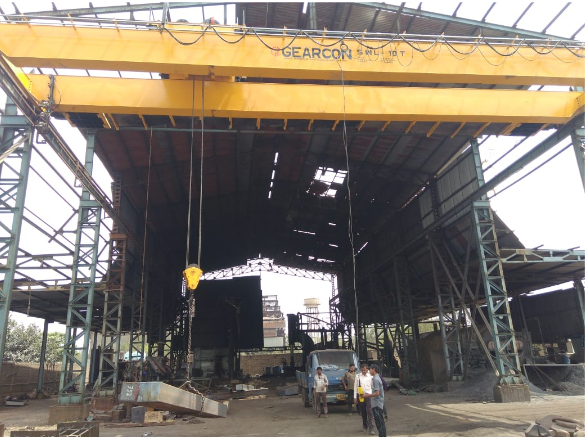
Double Girder EOT Crane Price in India 2026
If you're comparing quotes from Double Girder EOT Crane manufacturers in India and the numbers you're getting back vary by a wide margin for what looks like "the same crane," you're not imagining it — double girder EOT crane pricing is one of the least standardized figures in industrial procurement, precisely because so many independent variables feed into it. Anyone quoting a flat per-ton price without first asking about your span, lift height, and duty class is quoting a guess.
Here's what actually moves the number, so you can evaluate any quotation — ours included — on real technical grounds instead of just the bottom line.
The Variables That Actually Set Double Girder EOT Crane Price
1. Capacity (SWL) Double girder cranes are typically specified above the range where single girder designs stop making structural sense — commonly starting around 10–15 tons and going up to 80 tons and beyond for heavy industrial applications. Price does not scale linearly; the structural steel, gearbox rating, and wheel/rail loading all increase disproportionately as capacity rises.
2. Span The distance between runway rails directly affects main girder design — bending moment increases with span for a given load, which means longer spans need deeper, heavier girders even at identical capacity.
3. Lift Height Taller lift requirements mean longer wire rope, larger drum sizing, and in some cases a different hoist trolley configuration altogether.
4. Duty Classification (IS: 3177 / IS: 4137) This is the variable that separates a crane built for occasional lifting from one built for near-continuous heavy-industry cycling. Two cranes at the same capacity and span can differ meaningfully in price based on duty class alone, because higher duty class demands heavier-rated gearboxes, wheels, and structural members.
5. Trolley Configuration Single-trolley vs twin-trolley (for very heavy or oversized loads) changes both structure and hoist requirements significantly.
6. Site-Specific Factors Runway beam condition, headroom availability, and whether the crane is for a new building or a retrofit into an existing structure all affect final installed cost — not just the crane's ex-works price.
Indicative Price Positioning by Capacity Band
|
Capacity Band |
Typical Span |
Common Application |
Relative Price Positioning |
|
10–20 Ton |
15–25 m |
General steel/material handling |
Entry-level double girder |
|
20–35 Ton |
20–30 m |
Steel plant process areas, heavy fabrication |
Mid-range |
|
35–50 Ton |
25–35 m |
Power sector equipment, heavy engineering |
Mid-to-high |
|
50–80 Ton |
30 m and above |
Steel mills, heavy industry, hot metal handling |
High |
These bands reflect relative pricing position, not fixed figures — duty class and site conditions can shift a crane from one band's typical pricing into the next. A proper quotation always follows a technical discussion, not the other way around.
Why "Price Per Ton" Is a Misleading Way to Compare Quotes
Buyers often try to normalize competing quotes into a "price per ton" figure to compare vendors quickly. This works reasonably well for identical span and duty class — it breaks down completely the moment those two variables differ, which they almost always do between vendors. A lower per-ton price on a lower duty class crane isn't a better deal; it's a different, lighter-duty product that may not survive your actual operating cycle. Always confirm duty class is matched across every quote before comparing per-ton figures.
Where Double Girder EOT Cranes Are in Highest Demand: Odisha and Jharkhand
Odisha's steel and mining infrastructure — particularly the Kalinganagar and Jajpur corridor — runs process-heavy operations that regularly specify double girder EOT cranes in the 35–80 ton range for billet, coil, and hot metal handling. Duty class here is almost always heavy to very heavy, given near-continuous plant operation.
Jharkhand's Jamshedpur and Bokaro steel belt shows a similar demand pattern, with double girder cranes commonly specified for process bay material handling where headroom is tightly constrained by existing plant structures — making the crane's structural height, not just its capacity, a critical spec.
If you're budgeting a project in either state, get your span and duty class fixed early — it's the single biggest lever on final price, more than capacity alone.
How Gearcon Prices and Engineers Double Girder EOT Cranes
We manufacture Overhead EOT Cranes, including double girder configurations, to IS: 807, IS: 4137, and IS: 3177, up to 80 tons capacity. Because our gearboxes, gears, and gear couplings are manufactured in-house — a capability that predates our crane division and goes back to 1993 — we're able to engineer duty class precisely to your cycle frequency rather than defaulting to a standard rating that inflates cost unnecessarily or, worse, underspecs your application.
Our Product Range
- Overhead EOT Cranes
- Hot Metal / Ladle Cranes
- Goliath & Semi-Goliath Cranes
- Jib Cranes
- Grabbing Cranes
- Electric Wire Rope Hoists
- Gear Boxes
- Gears, Gear Couplings & Sprockets
- Spares
Why Buyers Choose Gearcon for Double Girder EOT Cranes
- In-house gearbox, gear, and coupling manufacturing — full control over duty class engineering
- Full compliance with IS: 807, IS: 4137, and IS: 3177
- Up to 80-ton manufacturing capability
- Manufacturing facility spanning 12,000+ sq. meters, with a 200+ person team
- Ancillary supplier to SAIL / Bhilai Steel Plant — heavy industrial performance is table stakes for this relationship
- Full after-sales, maintenance, and spares support
Learn more at About Gearcon and see our facility at Manufacturing.
FAQs
Why can't I get a fixed price for a double girder EOT crane without a technical discussion?
Because capacity, span, lift height, and duty class each independently affect price. A number given without these details is a rough estimate at best, not a real quote.
What's the maximum capacity Gearcon manufactures for double girder EOT cranes?
Up to 80 tons, engineered to IS: 807, IS: 4137, and IS: 3177.
Is a higher price always a sign of a better crane?
Not necessarily — but an unusually low price relative to competing quotes at the same capacity and span is almost always a sign of a lower duty classification, which may not suit continuous heavy-industry use.
Does Gearcon quote installed cost or ex-works cost?
We discuss both as part of the enquiry, since site conditions like runway beam readiness and headroom directly affect installation scope and cost.
Request a Technically Accurate Quote
Share your capacity, span, lift height, and expected duty cycle, and we'll return a properly engineered quotation — not a generic per-ton estimate. Enquire now or contact us.
Works: G.E. Road, Tedesara, Rajnandgaon, Chhattisgarh (India), 491441 Office: 1445 Gearcon House, Adarsh Nagar, Durg, Chhattisgarh (India) Phone: +91 9039067094 | Email: gearcon@rediffmail.com