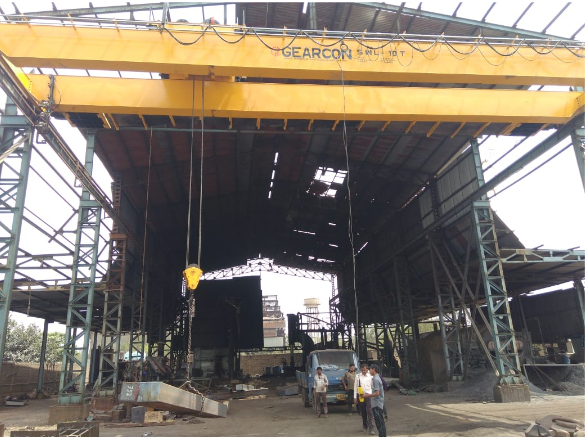
Semi Goliath vs Full Goliath Crane: Which Saves More on Civil Foundation Cost
If you've started evaluating Goliath crane manufacturers in India for a new fabrication yard, port facility, or steel stockyard, you've probably hit a decision point that gets glossed over in most sales conversations: should you go with a full Goliath crane (legs on both rails) or a semi-Goliath crane (one leg on a rail, the other end running on an elevated gantry or building structure)? The crane itself is only part of the cost. The bigger, quieter cost driver is what goes into the ground underneath it — and that's where the two designs genuinely diverge.
This isn't a "which is better" question. It's a "which is better for your site" question, and the answer changes the moment you know your soil report and your building layout.
Why Foundation Cost Is the Real Decision Point
A full Goliath crane runs on two independent ground-level rail tracks, which means two full-length foundation beams, two sets of rail clamps, two runs of civil compaction work, and — depending on soil bearing capacity — possibly piling on both sides. A semi-Goliath crane eliminates one of those foundations entirely by resting one end on an existing building column, gantry, or elevated structure.
On paper, that sounds like semi-Goliath always wins on cost. In practice, it depends on three things:
- Whether you already have a structure strong enough to carry a rail leg — retrofitting an existing shed column to bear crane-leg loads can cost more than just pouring a second foundation from scratch.
- Soil condition at your site — poor bearing soil pushes full-Goliath foundation costs up sharply (more piling, deeper rafts), which is exactly when semi-Goliath starts looking attractive.
- Span and capacity — at higher tonnage and wider spans, the load per foundation point increases on both designs, but a full Goliath spreads that load across two independently engineered foundations, which can actually be the safer long-term choice for very heavy, very wide spans like ship-hull yards or heavy fabrication bays.
Full Goliath vs Semi-Goliath: Side-by-Side
|
Factor |
Full Goliath Crane |
Semi-Goliath Crane |
|
Ground-level rail tracks required |
2 |
1 |
|
Dependent on existing building structure |
No |
Yes (one end) |
|
Typical civil/foundation cost |
Higher |
Lower — if a suitable structure already exists |
|
Best suited for |
Open yards, ports, ship-building, standalone stockyards |
Sites with an adjoining shed/building on one side |
|
Structural load distribution |
Independent, symmetrical |
Shared with existing building — needs structural audit |
|
Long-term maintenance of civil works |
Two rail foundations to maintain |
One rail foundation + building structural checks |
The pattern our engineering team sees on-site again and again: semi-Goliath only saves money when the existing structure was already designed with spare load capacity, or is over-designed relative to its current use. If that structure needs reinforcement to take a crane leg, the "savings" evaporate fast, and in some cases a semi-Goliath ends up more expensive than a straightforward full Goliath crane once structural strengthening is factored in.
Where This Decision Matters Most: Odisha and Gujarat
Two states illustrate this trade-off well, and both are core markets for us.
Odisha has some of India's densest steel, mining, and port-handling infrastructure — Paradip, Jajpur, and the Kalinganagar steel corridor all run heavy stockyard and scrap-handling operations where full Goliath cranes dominate, simply because most of these are open-yard operations with no adjoining structure to lean on. Soil conditions near the coast also tend to demand deeper, more carefully engineered foundations, which is exactly the kind of civil planning our team does before a single crane component is fabricated.
Gujarat, on the other hand, has a very different profile — dense fabrication units, shipbreaking yards (Alang), and heavy engineering plants in Vadodara, Bharuch, and Hazira, many of which already have large industrial sheds with spare structural capacity. This is where semi-Goliath cranes genuinely earn their reputation for cost savings, because the second foundation is often unnecessary.
If your site sits in either of these clusters, the honest first step isn't picking a crane type — it's getting a soil report and a structural audit of any adjoining building. We factor both into every Goliath and Semi-Goliath crane proposal before quoting.
What Gearcon Brings to This Decision
We've been manufacturing Goliath and Semi-Goliath cranes to IS: 807 and IS: 4137 design codes since our crane division, Gearcon Cranes, was established in 2019 — built on top of a gear and gearbox manufacturing base that goes back to 1993. That matters here specifically because the crane's travel, hoisting, and long-travel gearboxes are engineered in-house rather than outsourced, which means the load path calculations for both full and semi-Goliath configurations are done by the same team designing the structure — not handed off to a third-party fabricator.
We manufacture cranes up to 80 tons, and every Goliath or Semi-Goliath order goes through a structural feasibility check before we finalize whether your site is better suited to one design over the other — we'd rather tell you honestly which one is cheaper for your site than sell you the one with the bigger margin.
Our Product Range
- Overhead EOT Cranes
- Hot Metal / Ladle Cranes
- Goliath & Semi-Goliath Cranes
- Jib Cranes
- Grabbing Cranes
- Electric Wire Rope Hoists
- Gear Boxes
- Gears, Gear Couplings & Sprockets
- Spares
Why Procurement Teams Choose Gearcon
- Full-code compliance — every Goliath and Semi-Goliath crane is designed to IS: 807 and IS: 4137
- 80-ton manufacturing capability with in-house gearbox and gear-coupling production
- Ancillary to SAIL / Bhilai Steel Plant — a heavy-industry relationship that requires consistent, code-compliant delivery
- 200+ person team working out of a manufacturing facility spread over 12,000+ sq. meters
- Dedicated after-sales and service team for maintenance and spares, so the relationship doesn't end at commissioning
Read more about who we are on our About Gearcon page, or see our facility directly on the Facility page.
FAQs
Is a semi-Goliath crane always cheaper than a full Goliath crane? No. It's only cheaper when an existing structure can safely carry a crane rail leg without reinforcement. If the structure needs strengthening, a full Goliath crane can end up being the more economical option.
What design codes do Gearcon's Goliath cranes follow? All our Goliath and Semi-Goliath cranes are manufactured according to IS: 807, IS: 4137, and other applicable Indian Standard codes.
What's the maximum capacity Gearcon manufactures for Goliath cranes? We manufacture Goliath and Semi-Goliath cranes up to 80 tons, engineered to match your site's span and load requirements.
Do you help evaluate whether our site is better suited to full or semi-Goliath? Yes — our team reviews soil conditions and any adjoining structure before recommending a configuration, rather than defaulting to one type.
Get a Foundation-Aware Goliath Crane Quote
Don't finalize your civil scope before you know which crane configuration actually fits your site. Enquire with our team for a site-specific recommendation, or contact us directly.
Works: G.E. Road, Tedesara, Rajnandgaon, Chhattisgarh (India), 491441 Office: 1445 Gearcon House, Adarsh Nagar, Durg, Chhattisgarh(India) Phone: +91 9039067094 | Email: gearcon@rediffmail.com