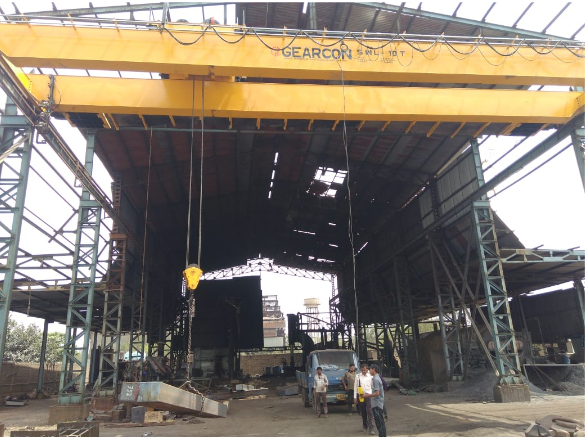
Electric Wire Rope Hoist Price in India 2026
Every buyer researching Electric Wire Rope Hoists in India eventually asks the same question directly: "what's it going to cost?" Fair question — and also one that no honest manufacturer can answer with a single flat number, because hoist pricing is driven by four or five independent variables that change from one enquiry to the next. If you've seen a website quote a fixed rupee figure for "a wire rope hoist" with no capacity, lift height, or duty class attached, treat it as a marketing number, not a real quotation.
What we can give you instead is exactly what drives the price up or down, so that when you do request a quote — from us or anyone else — you know whether the number you're looking at makes sense.
What Actually Determines Wire Rope Hoist Price
1. Safe Working Load (SWL) The most obvious driver. Hoists typically range from under 1 ton for light-duty applications up to 20+ tons for heavy industrial lifting. Price doesn't scale linearly with capacity — the jump from 1 ton to 5 ton is proportionally smaller than 10 ton to 20 ton, because structural and gearbox requirements increase disproportionately at higher loads.
2. Lift Height Rope length, drum size, and motor sizing all increase with lift height. A hoist rated for a 6-meter lift and one rated for a 15-meter lift at the same SWL are not the same price, even though the capacity label looks identical.
3. Duty Class / FEM or IS Classification This is the variable most first-time buyers miss entirely. A hoist running light, occasional lifts needs a lower duty classification than one running near-continuous cycles in a production line. Higher duty class means heavier-rated gearboxes, motors, and wire rope — and a meaningfully higher price for the same SWL and lift height.
4. Single Girder vs Double Girder Mounting Wire rope hoists mounted on single girder cranes are generally more economical than double girder configurations, which typically support higher capacities and headroom-optimized designs.
5. Control System Basic pendant/push-button control is the lowest-cost option. Radio remote control, variable frequency drives (VFD) for smooth acceleration/deceleration, and automated positioning systems all add cost — but also reduce operator strain and improve cycle precision in high-throughput environments.
Indicative Price Movement by Capacity Band
|
SWL Range |
Typical Lift Height |
Relative Price Positioning |
Common Use Case |
|
Up to 1 Ton |
Up to 6 m |
Entry-level |
Light workshops, tool rooms, small assembly lines |
|
1–5 Ton |
6–10 m |
Low-Medium |
General manufacturing, warehousing |
|
5–10 Ton |
8–12 m |
Medium |
Heavy fabrication, steel component handling |
|
10–20 Ton |
10–15 m |
Medium-High |
Steel plants, heavy engineering, power sector |
|
20 Ton+ |
15 m and above |
High |
Heavy industry, custom industrial applications |
This table shows relative price positioning by band, not fixed rupee figures — actual pricing depends on duty class, control system, and site-specific engineering. Any manufacturer quoting an exact price before knowing your duty class and lift height is guessing, not quoting.
The Honest Answer: Get Duty Class Right Before You Compare Quotes
If you're comparing quotations from multiple manufacturers and the numbers look wildly different for "the same" hoist, the first thing to check is duty classification — not brand reputation. A lower-duty-class hoist will always look cheaper on paper, and it will also fail sooner under heavy cycling. Match quotes on SWL, lift height, and duty class before comparing rupee figures, or you're not actually comparing the same product.
Where Wire Rope Hoist Demand Is Highest: Gujarat and Maharashtra
Gujarat carries the single largest concentration of fabrication units, ports, and heavy engineering operations in India — Ahmedabad, Vadodara, Surat, and the Hazira industrial belt all run continuous-duty material handling operations where hoist duty class, not just capacity, decides total cost of ownership over the equipment's life.
Maharashtra's industrial corridor — Pune, Nashik, and Nagpur in particular — runs a dense mix of auto-ancillary, general manufacturing, and heavy engineering facilities, where mid-capacity hoists (1–10 ton) in the 6–12 meter lift range are the most commonly specified configuration.
If you're procuring for a facility in either state, request quotes with SWL, lift height, and duty class fixed across every vendor before comparing prices — it's the only way the comparison means anything.
What Gearcon Offers
We manufacture Electric Wire Rope Hoists built on the same in-house gear and gearbox manufacturing base that's been running since 1993 — which means the gearbox inside your hoist isn't a third-party bought-out component, it's engineered and produced by the same team quoting your project.
Our Product Range
- Overhead EOT Cranes
- Hot Metal / Ladle Cranes
- Goliath & Semi-Goliath Cranes
- Jib Cranes
- Grabbing Cranes
- Electric Wire Rope Hoists
- Gear Boxes
- Gears, Gear Couplings & Sprockets
- Spares
Why Buyers Choose Gearcon for Wire Rope Hoists
- In-house gearbox, gear, and coupling manufacturing — full control over duty class and quality, start to finish
- Transparent duty-class discussion before quoting, not after
- Manufacturing facility of 12,000+ sq. meters with a 200+ person team
- Ancillary supplier to SAIL / Bhilai Steel Plant — proof of consistent heavy-duty performance
- Dedicated after-sales, maintenance, and spares support
More on our background at About Gearcon and our Facility.
FAQs
Why won't Gearcon give a flat price for a wire rope hoist online? Because SWL, lift height, duty class, and control system all change the price independently — a flat number without these details would either mislead you or misquote the job. We'd rather ask three questions and give you an accurate figure.
What's the most common mistake buyers make when comparing hoist quotes? Comparing prices without matching duty classification. Two hoists at the same SWL can differ substantially in price and lifespan based on duty class alone.
Does Gearcon manufacture hoists for single girder and double girder cranes? Yes, our Electric Wire Rope Hoists are engineered for both single and double girder configurations depending on your capacity and headroom requirements.
What control options are available? Standard pendant/push-button control, along with radio remote and VFD-based options for smoother, more precise operation in high-cycle environments.
Get an Accurate Wire Rope Hoist Quote
Send us your SWL, lift height, and cycle frequency, and we'll return a duty-class-matched quotation — not a guess. Enquire now or contact us directly.
Works: G.E. Road, Tedesara, Rajnandgaon, Chhattisgarh (India), 491441 Office: 1445 Gearcon House, Adarsh Nagar, Durg, Chhattisgarh (India) Phone: +91 9039067094 | Email: gearcon@rediffmail.com