Single Girder vs Double Girder EOT Crane: A Load Cost and Headroom Comparison
Somewhere between "we need an overhead crane" and finalizing a purchase order, almost every buyer runs into the single vs double girder question — and most vendor websites answer it with a one-line rule ("double girder for heavy loads") that isn't wrong, exactly, but leaves out the two variables that actually decide the answer for your building: available headroom and true total cost of ownership.
This comparison walks through all three axes — load, cost, and headroom — because a decision made on load capacity alone, without checking the other two, is how buyers end up with a crane that doesn't fit their building or costs more than necessary for the job it's actually doing.
The Structural Difference, Briefly
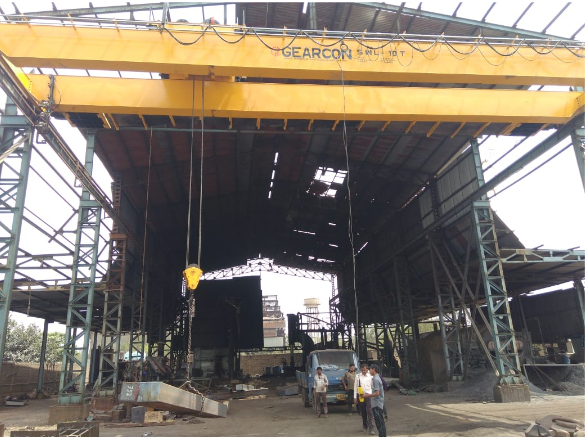
A single girder EOT crane runs the hoist trolley along the bottom flange of a single main girder. A double girder EOT crane uses two parallel girders with the trolley running on top, between them. That structural difference is the root cause of every downstream difference in capacity, cost, and headroom — everything below follows from it.
Load Capacity
Single girder cranes are the standard choice up to roughly 10–15 tons, depending on span. Beyond that range, the single girder's bending and torsional limits make a double girder design structurally more efficient — you get more capacity per unit of structural steel weight with two girders sharing the load path than with one girder trying to carry it alone at longer spans.
If your facility's heaviest lift genuinely stays under this threshold and isn't likely to grow, a single girder crane isn't a compromise — it's the technically correct, more economical choice.
Cost
This is where buyers most often assume "single girder is always cheaper" without checking the specifics. It's generally true at lower capacities and shorter spans. But the gap narrows — and can occasionally reverse — as span increases, because a single girder crane pushed toward the upper edge of its practical capacity range needs a disproportionately heavier girder section to stay within deflection limits, which can erode much of its cost advantage over a well-designed double girder alternative at the same capacity.
The honest rule: below 10 tons and moderate spans, a single girder almost always wins on cost. Above that, get both configurations quoted before assuming a single girder is automatically cheaper — sometimes it isn't, once you account for the heavier structural steel a stretched single girder design requires.
Headroom
This is the factor most frequently missed at the enquiry stage, and it's often the deciding one in practice. Double girder cranes, because the trolley runs on top of the girders rather than underneath, generally require more headroom for the same hook height than a single girder crane, which mounts the trolley below the girder. In a building with generous roof height, this is a non-issue. In a retrofit into an existing shed with a fixed, limited eave height, it can rule out double girder entirely, regardless of load requirements — or force a compromise on maximum hook height that affects your operations.
If you're specifying a crane for an existing building rather than new construction, get the available headroom measured and confirmed before deciding between single and double girder — not after.
Side-by-Side Comparison
|
Factor |
Single Girder EOT Crane |
Double Girder EOT Crane |
|
Typical capacity range |
Up to ~10–15 tons |
10 tons and above, up to 80 tons |
|
Structural efficiency at longer spans |
Reduces as span increases |
More efficient at heavy loads/long spans |
|
Cost at lower capacity/shorter span |
Generally lower |
Generally higher |
|
Cost at higher capacity/longer span |
Can narrow or occasionally reverse |
Often more cost-efficient per ton |
|
Headroom required for same hook height |
Lower |
Higher |
|
Ideal for |
Light-to-medium industry, warehousing, general fabrication |
Steel plants, heavy fabrication, power sector, hot metal handling |
|
Applicable IS codes |
IS: 807, IS: 4137 |
IS: 807, IS: 4137, IS: 3177 |
Where This Decision Plays Out: Chhattisgarh and West Bengal
Chhattisgarh — our home state, and the base of the SAIL / Bhilai Steel Plant ecosystem we're an ancillary supplier to — runs a dense mix of both configurations. General manufacturing and warehousing operations across Raipur and Durg typically specify single girder cranes, while process areas within the Bhilai steel corridor run double girder cranes for heavier billet, coil, and hot metal handling where headroom is usually generous but load and duty class are demanding.
West Bengal's Durgapur–Asansol steel belt shows a similar pattern, but with a specific added constraint: many of the older industrial sheds in this corridor have fixed, limited headroom from decades-old construction, making the headroom question genuinely decisive rather than academic. Buyers here retrofitting cranes into existing structures should treat available headroom as a hard constraint to check first, before even requesting capacity-based quotes.
How Gearcon Approaches This Decision
We manufacture both single and double girder Overhead EOT Cranes to IS: 807, IS: 4137, and IS: 3177, up to 80 tons capacity — and we ask about your building's available headroom and existing runway structure before recommending a configuration, not after. Our gearboxes, gears, and gear couplings are manufactured in-house, a capability rooted in our engineering base since 1993, which lets us match duty class and structural design precisely to your site rather than pushing a standard catalog spec that may not physically fit your building.
Our Product Range
- Overhead EOT Cranes
- Hot Metal / Ladle Cranes
- Goliath & Semi-Goliath Cranes
- Jib Cranes
- Grabbing Cranes
- Electric Wire Rope Hoists
- Gear Boxes
- Gears, Gear Couplings & Sprockets
- Spares
Why Gearcon Gets This Recommendation Right
- Site-first specification — headroom and runway condition reviewed before recommending girder type
- In-house gearbox, gear, and coupling manufacturing for accurate duty-class engineering
- Full compliance with IS: 807, IS: 4137, and IS: 3177
- Manufacturing facility of 12,000+ sq. meters with a 200+ person team
- Ancillary supplier to SAIL / Bhilai Steel Plant — proven heavy-duty crane performance
- After-sales, spares, and maintenance support across both single and double girder cranes
More about us: About Gearcon | Facility
FAQs
Is double girder always the better choice for heavy loads?
Structurally, yes, above roughly 10–15 tons — but "better" also depends on your building's headroom. A double girder crane that doesn't physically fit your existing structure isn't the right choice regardless of load capacity.
Can a single girder crane be upgraded to double girder later?
Generally no, not as a simple upgrade — the runway, building structure, and headroom are typically designed around one configuration from the start. This is why getting the decision right at the specification stage matters.
Does double girder always cost more?
At lower capacities and shorter spans, yes. At higher capacities and longer spans, the cost gap narrows and can occasionally favor double girder once you account for the heavier steel a stretched single girder design would need.
What should I check before requesting quotes?
Confirm your required capacity, span, and — critically — your building's available headroom at the eave and any existing runway beam condition, before comparing single vs double girder quotes.
Get a Site-Matched Recommendation
Tell us your required capacity, span, and available headroom, and we'll recommend the configuration that actually fits your building — not just your load chart. Enquire now or contact us.
Works: G.E. Road, Tedesara, Rajnandgaon, Chhattisgarh (India), 491441 Office: 1445 Gearcon House, Adarsh Nagar, Durg, Chhattisgarh (India) Phone: +91 9039067094 | Email: gearcon@rediffmail.com