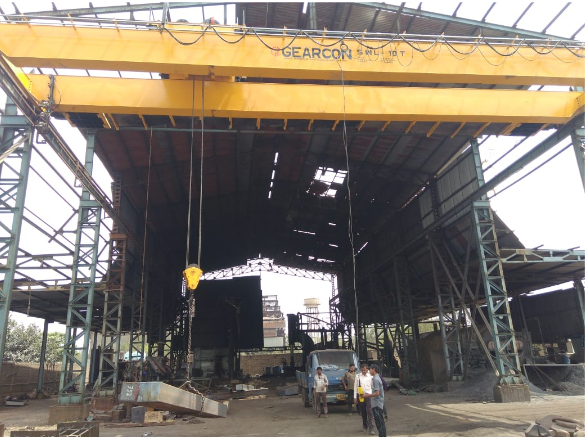
Goliath Crane Load Capacity Chart: 5 Ton to 80 Ton
Most buyer conversations around Goliath crane manufacturers in India start with the same vague brief: "we need a Goliath crane for our yard." That's not enough information to design anything. Load capacity, span, lift height, and duty class together decide the entire crane's structure, gearbox rating, and rail design — get the capacity wrong at the enquiry stage and you either overpay for structural steel you'll never use, or underspec a crane that fatigues early under real working loads.
This is a technical reference, not a sales pitch — use it to sanity-check any quotation you're comparing, from us or anyone else.
How Goliath Crane Capacity Actually Scales
A Goliath crane's capacity rating isn't just "how much weight can it lift." It's a function of four interacting variables:
- Safe Working Load (SWL) — the maximum load the crane is rated to lift under normal operation
- Span — the horizontal distance between the two rail legs; longer spans increase bending moment on the main girder for the same SWL
- Lift height — affects hoist rope length, drum size, and overall structural height
- Duty class (per IS: 807) — how frequently and how close to full load the crane operates; a crane running near-continuous heavy cycles needs a higher duty class than one used occasionally
Two cranes rated at the same SWL can have very different structural steel weights, gearbox ratings, and price points depending on span and duty class alone.
Goliath Crane Capacity Chart (Indicative, by Tonnage Band)
|
Capacity Band |
Typical Span Range |
Common Duty Class (IS: 807) |
Typical Application |
|
5–10 Ton |
Up to 20–25 m |
Light to Medium |
Warehousing, general material yards, small fabrication |
|
10–20 Ton |
20–30 m |
Medium |
Structural steel yards, precast concrete handling |
|
20–35 Ton |
25–35 m |
Medium to Heavy |
Steel billet/coil handling, scrap yards |
|
35–50 Ton |
30–40 m |
Heavy |
Heavy fabrication, shipyard component handling, power plant equipment |
|
50–80 Ton |
35 m and above |
Heavy to Very Heavy |
Ship-building, large equipment assembly, mining/ore handling |
This chart is indicative and directional — actual gearbox rating, girder profile, and duty class are always finalized against your specific span, lift height, and cycle frequency after a technical review. Treat any published capacity chart, including this one, as a starting point for your enquiry, not a final specification.
Why Duty Class Gets Overlooked (and Shouldn't)
Two buyers can order a "20-ton Goliath crane" and receive two structurally different machines. A steel yard running the crane in near-continuous cycles all shift needs a heavier duty classification than a facility that lifts occasionally for maintenance or loading. Under-speccing duty class is the single most common reason Goliath cranes develop premature wear on end trucks, wheels, and long-travel gearboxes — and it's rarely visible in a basic quotation unless you specifically ask for it.
When you request a quote for a Goliath crane or Overhead EOT crane, always confirm the duty classification in writing — not just the tonnage.
Where This Capacity Range Gets Used: Jharkhand and West Bengal
Jharkhand is home to some of India's heaviest steel and mining infrastructure — Jamshedpur, Bokaro, and the surrounding mineral belt run material handling operations that regularly demand cranes in the 35–80 ton range for ore, scrap, and heavy billet handling. These are exactly the applications where duty class, not just tonnage, determines whether a crane lasts its full design life or needs major overhaul within a few years.
West Bengal's Durgapur–Asansol steel corridor runs a similar profile, with a mix of mid-tonnage (20–35 ton) cranes for general steel handling and heavier units for specific process areas. Buyers in this belt are typically comparing multiple manufacturers on capacity charts that look identical on paper — the differentiator ends up being duty class engineering and after-sales support, not the headline tonnage number.
If you're sourcing for a plant in either state, treat the capacity number as the opening line of the conversation, not the whole spec.
How Gearcon Engineers Around This Chart
We manufacture Goliath and Semi-Goliath cranes up to 80 tons, built to IS: 807 and IS: 4137, with gearboxes and gear couplings produced in-house rather than sourced from a third party — a direct result of our engineering base going back to 1993, well before we entered crane manufacturing in 2012 and formalized Gearcon Cranes in 2019. That in-house gearbox capability is precisely why we can match duty class to your actual cycle frequency instead of defaulting to a standard rating that may not fit your operation.
Our Product Range
- Overhead EOT Cranes
- Hot Metal / Ladle Cranes
- Goliath & Semi-Goliath Cranes
- Jib Cranes
- Grabbing Cranes
- Electric Wire Rope Hoists
- Gear Boxes
- Gears, Gear Couplings & Sprockets
- Spares
Why Engineers and Procurement Teams Prefer Gearcon
- In-house gear, gearbox, and coupling manufacturing — not outsourced components bolted onto a bought-in structure
- Full compliance with IS: 807 and IS: 4137 duty class and design requirements
- Manufacturing facility spread across 12,000+ sq. meters, with a 200+ person engineering and production team
- Ancillary supplier to SAIL / Bhilai Steel Plant — a relationship that demands consistent heavy-duty crane performance
- After-sales service and spares support for the full working life of the crane
Learn more on our About Gearcon page and Facility page.
FAQs
Does a higher tonnage always mean a bigger crane price jump? Not proportionally — span and duty class often move the price more than tonnage alone. A shorter-span, lower-duty 20-ton crane can cost less than a longer-span, heavy-duty 15-ton crane.
What's the maximum Goliath crane capacity Gearcon manufactures? We manufacture Goliath and Semi-Goliath cranes up to 80 tons, engineered to IS: 807 and IS: 4137.
Why does duty class matter more than the tonnage rating? Duty class reflects how often and how close to full load the crane actually operates. Two cranes with identical tonnage but different duty classes will have different structural life spans under the same operating conditions.
Can Gearcon customize capacity and span together for our site? Yes — every quotation is engineered against your specific span, lift height, and cycle frequency rather than a fixed catalog spec.
Request a Capacity-Matched Quote
Send us your span, lift height, and expected cycle frequency, and we'll return a duty-class-matched capacity recommendation — not just a tonnage number. Enquire now or get in touch.
Works: G.E. Road, Tedesara, Rajnandgaon, Chhattisgarh (India), 491441 Office: 1445 Gearcon House, Adarsh Nagar, Durg, Chhattisgarh (India) Phone: +91 9039067094 | Email: gearcon@rediffmail.com