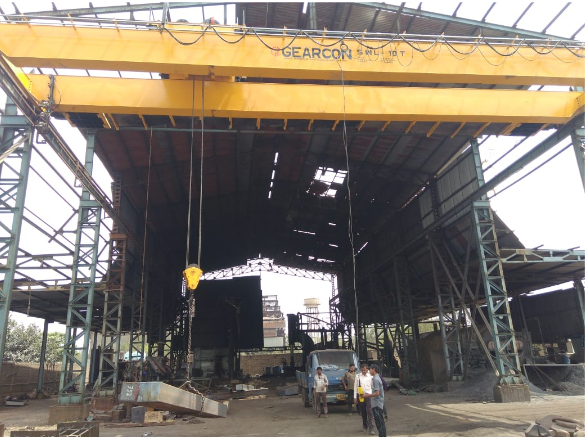
Top 10 Overhead EOT Crane Manufacturers in India
Best Industrial Crane Companies
Industrial material handling demands absolute precision, unyielding structural integrity, and strict safety compliance. When moving heavy structural steel, molten metals, or large automotive assemblies, choosing the right material handling system dictates both operational efficiency and workplace safety.
India’s manufacturing landscape has experienced unprecedented growth, directly accelerating the demand for rugged industrial lifting machinery. This comprehensive guide provides an analytical review of top industrial crane solutions, focusing on heavy-duty design parameters, engineering compliance, and structural standards across the subcontinent.
India’s Best Overhead EOT Crane Manufacturers for Industrial Lifting Solutions
An electric overhead traveling crane, commonly known as an EOT crane, is the mechanical backbone of modern industrial facilities. Comprising a parallel runway system with a traveling bridge spanning the gap, these systems provide precise three-axis material movement across factory floors.
Heavy industries rely on these systems to streamline production workflows, minimize manual labor hazards, and optimize vertical storage footprints. From automated production lines to aggressive foundry environments, securing a partner from the premier overhead EOT crane manufacturers in India ensures your infrastructure is optimized for continuous, high-capacity throughput.
Technical Performance Profiles of Leading Industrial Crane Systems
Gearcon Engineering (Premium Heavy-Duty & Integrated Drive Systems)
Company Overview
Gearcon Engineering has established a prominent reputation among overhead EOT crane manufacturers in India by leveraging its foundational heritage in high-precision gear and gearbox manufacturing. Unlike conventional assemblers, the company constructs its heavy-duty crane gearboxes, rope drums, and drive assemblies entirely in-house. This comprehensive manufacturing control translates directly to superior operational longevity and structural resilience under continuous duty cycles.
Years of Experience
Operating with over 33 years of engineering background since its inception in 1993, expanding directly into large-scale overhead crane systems in 2012.
Types of Cranes Manufactured
- Single Girder Overhead Cranes (Low-headroom variants)
- Double Girder Heavy-Duty Cranes
- Hot Metal / Ladle Foundry Cranes
- Gantry / Goliath Systems
Industries Served
Primary metallurgical steel plants, mineral processing facilities, heavy engineering workshops, and continuous production lines.
Load Capacity Range
From 1 Ton up to 80+ Ton configurations.
Safety & Certifications
Fully compliant with IS 3177, IS 4137, and IS 807 design standards; built using ISO-certified structural processing frameworks.
Custom Crane Solutions
Provides precise tailoring for hazardous, high-ambient temperature zones, specialized long-span architectural frameworks, and unique micro-speed hoisting configurations.
Installation & After-Sales Service
Provides complete site erection, operational proof-load testing, structural safety verification, and round-the-clock emergency field-engineering response.
Why Choose Gearcon Engineering
Choosing this manufacturer ensures your systems feature heavy-duty, in-house machined gear trains that offer superior wear resistance compared to standard commercial gearboxes. Their structural designs minimize deadweight while preserving high rigidity, making them a premier option for high-duty cycle steelworks and demanding manufacturing plants.
What is an Overhead EOT Crane?
Meaning of EOT Crane
An EOT crane stands for Electric Overhead Traveling Crane. It is an electrically powered machine designed to lift, lower, and horizontally transport heavy, bulky materials within a defined spatial grid. These systems operate on an elevated runway structure, preserving valuable warehouse and factory floor space.
How Overhead Cranes Work
The operational mechanics of an EOT crane rely on a system of balanced electrical drives working in tandem:
- Hoisting Mechanism: An electric hoist or open winch trolley raises and lowers loads vertically via high-tensile steel wire ropes hooked to a bottom block.
- Cross Travel (CT): The trolley moves horizontally along the bridge girders, allowing side-to-side positioning.
- Long Travel (LT): The entire bridge structure moves longitudinally along elevated gantry rails, enabling full length-of-factory material transport.
Main Components of an EOT Crane
A standard industrial EOT crane is an integration of several structural and mechanical assemblies:
- Bridge Girders: The primary horizontal structural beams (box plate or rolled I-beams) that span the bay.
- End Carriages: Structures mounted on both sides of the bridge housing the wheels, bearings, and LT gearmotors.
- Crab / Trolley Frame: The moving carriage that supports the primary hoisting machinery.
- Rope Drum: A precision-grooved carbon steel cylinder that neatly winds and unwinds the hoisting wire rope.
- Braking Systems: Dual electromagnetic or electro-hydraulic thruster brakes installed on hoisting and traveling motions for immediate load holding.
- Electrical Panel: The centralized enclosure containing Variable Frequency Drives (VFDs), contactors, and safety relays.
Applications Across Industries
Industrial lifting equipment acts as the primary logistical interface across multiple critical sectors:
- Foundries: Transporting ladles filled with molten metal safely across pouring bays.
- Manufacturing Plants: Moving massive machinery components during precision assembly.
- Infrastructure & Construction: Handling heavy precast concrete beams and structural steel sections.
Types of Industrial Overhead Cranes Used in India
Single Girder EOT Crane
Single girder configurations utilize a single structural beam spanning the end trucks, with the hoist trolley traveling along the bottom flange of the girder.
- Capacities: Generally manufactured up to 20 Tons with spans stretching up to 30 meters.
- Industrial Use Cases: Light to medium manufacturing sectors, machine shops, assembly lines, and maintenance bays.
- Advantages: Highly cost-effective, low deadweight minimizes stress on building columns, and offers excellent low-headroom clearance.
Double Girder EOT Crane
Double girder models feature two parallel bridge beams supported by end carriages. The hoisting trolley travels along rails mounted directly to the top of these girders.
- Capacities: Built for extreme demands, easily handling loads from 20 Tons up to 80+ Tons with spans exceeding 40 meters.
- Industrial Use Cases: Steel melting shops, heavy engineering installations, continuous processing plants, and paper mills.
- Advantages: Delivers maximum hook height since the hoist sits between the girders, exceptional structural rigidity, and accommodates high-speed operations.
Gantry Crane
Also known as Goliath cranes, these systems feature overhead bridges supported by self-contained legs that travel along ground-level rails rather than elevated runways.
- Capacities: Tailored from 5 Tons up to 100+ Tons.
- Industrial Use Cases: Outdoor stockyards, shipping ports, scrap yards, and marble processing facilities.
- Advantages: Eliminates the need for overhead building columns, perfect for outdoor configurations.
Jib Crane
A localized lifting solution comprising a horizontal boom (jib) mounted to a floor-anchored pillar or a wall-facing structural column.
- Capacities: Usually capped between 0.5 Tons to 10 Tons.
- Industrial Use Cases: Individual workstations, machining cells, and loading docks.
- Advantages: Offers 180 to 360 degrees of rotation for fast, hyper-localized material positioning.
Underslung Crane
These cranes are suspended directly from the bottom flanges of the building’s roof roof-trusses, eliminating the need for traditional floor columns.
- Capacities: Typically customized up to 10 Tons.
- Industrial Use Cases: Aerospace manufacturing, high-precision electronic assembly facilities.
- Advantages: Optimizes floor workspace in narrow layout configurations.
Flameproof & Explosion-Proof Crane
Engineered with spark-resistant copper-alloy hooks, explosion-proof electrical enclosures, and insulated wiring systems.
- Capacities: Customized based on site hazards (typically 1 to 50 Tons).
- Industrial Use Cases: Chemical processing facilities, oil & gas refineries, and defense ammunition depots.
- Advantages: Complete safety assurance in volatile atmospheres containing explosive gases or combustible dust particles.
Technical Specifications Table of Industrial Overhead EOT Cranes
The table below covers structural variations, standard capacity limits, and mechanical features tailored by expert engineering setups for domestic factory profiles:
|
EOT Crane Classification |
Lift Capacity Range |
Maximum Standard Span |
Associated Duty Classes |
Primary Mechanical Driving Frameworks |
Target Industrial Applications |
Action |
|
Gearcon Single Girder EOT Crane |
Up to 20 Tons |
Up to 30 Meters |
M3 to M5 (Light to Medium Duty) |
Compact internal hoist motor, Variable Frequency Drives (VFD) |
General workshops, component handling, light assembly plants |
|
|
Gearcon Double Girder EOT Crane |
Up to 80+ Tons |
Up to 40+ Meters |
M5 to M8 (Heavy Duty Cycles) |
Heavy-duty open winch trolley, in-house machined gear trains, custom thruster brakes |
Steel manufacturing plants, heavy engineering bays, paper and cement mills |
|
|
Gearcon Hot Metal / Ladle Crane |
Custom up to 80 Tons |
Site-Specific Layout |
M7 to M8 (Continuous Severe Duty) |
Insulated slip-ring motors, duplicated master switches, heat-shielded operator cabins |
Heavy foundries, blast furnaces, molten metal pouring bays |
|
|
Gearcon Gantry / Goliath Crane |
Up to 80+ Tons |
Across Site Span Limits |
M4 to M7 (Outdoor Maintenance) |
Self-contained A-frame vertical leg tracking, floor-level runway rail wheels |
Outdoor raw material stockyards, marble processing, shipping docks |
How to Choose the Best EOT Crane Manufacturer in India
Selecting the right partner from various industrial crane companies setups requires reviewing specific engineering metrics beyond the base price quote:
Check Manufacturing Experience
Look for companies with a long track record. Material fatigue and structural deflection manifest over years of field operation; a manufacturer with decades of field installations understands exactly how to reinforce structural weld joints to survive continuous mechanical stress.
Evaluate Crane Quality Standards
Ensure the manufacturer adheres strictly to IS 3177 and IS 4137 design classes. Verify that structural steel matches grade IS 2062 and that ultrasonic or radiographic testing is performed on primary load-bearing box girder fillet welds.
Compare Customization Options
Industrial processes vary. If your facility operates in extreme heat (like steel casting) or handles precise machining parts, your manufacturer must possess the design capability to tailor gear ratios, incorporate Variable Frequency Drives (VFDs), or deliver custom micro-speeds.
Verify Safety Compliance
A high-quality crane must feature overlapping safety systems. Demand integrated thermal overload protection for motors, secure mechanical anti-derailment catches, dual thruster brakes on hoisting lines, and automated hook limit switches.
Assess Service Network
A broken crane stalls production across an entire bay. Prioritize companies that control their component fabrication (such as in-house gearbox machining) and keep essential spare parts like brake liners, rope guides, and contactors ready for immediate dispatch.
Understand Maintenance Support
Review the technical scope of the manufacturer's operational training and preventative maintenance contracts. Smooth execution of periodic wheel-alignment and runway rail-gantry profiling is vital to prevent premature wheel flange wear.
Compare Pricing & Warranty
Evaluate the total cost of ownership rather than just the initial procurement price. A cheap crane constructed with under-specced commercial components will rapidly rack up heavy maintenance costs, whereas an optimized structural design delivers minimal operational downtime over decades.
Industries That Use Overhead EOT Cranes
- Steel Plants: Continuous transport of scrap baskets, charging of melting furnaces, and safe transfer of ladles holding liquid steel at over 1500°C.
- Automotive Manufacturing: Moving die blocks to stamping presses and supporting automated sub-assembly chassis transport.
- Warehousing & Logistics: Quick, safe palletized handling and clearing of heavy industrial raw materials.
- Cement Industry: Heavy-duty clinker handling using automated dual-line grab buckets under dense dust profiles.
- Power Plants: Installation, structural upkeep, and overhaul maneuvers of high-capacity steam turbines and generator rotors.
- Heavy Engineering: Assembly of industrial boilers, pressure vessels, and large earthmoving machinery blocks.
- Shipbuilding Industry: Moving large fabricated hull blocks and positioning structural engine compartments into dry docks.
Latest Trends in Industrial Crane Technology
Smart EOT Cranes
Modern overhead lifting units incorporate integrated digital sensing arrays. These systems run software features like Electronic Anti-Sway Control, which modulates drive acceleration curves to completely neutralize load-swing momentum, protecting shop-floor workers.
IoT-Based Crane Monitoring
Using Internet of Things (IoT) sensors, cranes constantly broadcast operating data (motor temperatures, load cycles, brake wear indices) directly to cloud dashboards. Operators monitor structural stress levels remotely, preventing unexpected failures.
Automated Material Handling
Advanced warehouses deploy semi-automated or fully autonomous EOT platforms. Guided by laser radar (LiDAR) and absolute positioning encoders, these systems navigate to assigned storage bays and pick up heavy materials with zero manual operator input.
Energy-Efficient Crane Systems
Utilizing regenerative braking electronics, modern crane networks capture the kinetic energy generated while lowering heavy loads or braking long-travel motions, converting it back into electrical energy fed directly into the factory's main power grid.
Remote-Controlled Cranes
Replacing traditional suspended pendant controllers with ergonomically tuned Radio Remote Controls (RRC) or remote visual pulpits. This allows operators to pilot heavy machinery from safe zones, away from hot zones or suspended loads.
AI-Based Predictive Maintenance
Artificial Intelligence algorithms monitor real-time vibration telemetry from crane gearboxes and bearings. By identifying micro-frictional variances, the platform alerts maintenance staff to replace components weeks before a mechanical breakdown occurs.
Benefits of Choosing a Trusted Industrial Crane Manufacturer
- Higher Workplace Safety: Reduces risk profile through precise mechanical load holding and structural safety margins that exceed standard operating limits.
- Improved Productivity: Faster, smoother material transport accelerates overall plant throughput.
- Lower Maintenance Costs: Precision alignment and high-grade internal components prevent structural track wear and gear tooth chipping.
- Longer Crane Lifespan: A well-engineered industrial crane delivers reliable service life for over 25 to 30 years under standard maintenance regimes.
- Better Technical Support: Instant access to field engineers who understand structural load-strains and control system calibration.
- Faster Installation: Precise modular alignment ensures the system matches the elevated runway structures perfectly during field assembly.
Common Problems in Overhead EOT Cranes and Solutions
Crane Overloading
- The Problem: Operating a crane beyond its Rated Lifting Capacity strains structural welds, stretches wire ropes, and risks structural failure.
- The Solution: Retrofitting automated Electronic Load Cell Limiters that cut off hoist power the moment a load exceeds 102% of rated capacity.
Wire Rope Failure
- The Problem: Frictional wear, kinks, or accidental bird-caging caused by unspooling issues can compromise wire rope loops.
- The Solution: Installing heavy-duty nylon or cast-iron Rope Guides inside the drum grooves, combined with mandatory weekly lubrication inspections.
Motor & Brake Issues
- The Problem: Overheating drives or slipping thruster brakes, which can lead to load-drift hazards during micro-positioning.
- The Solution: Utilizing Class-F insulated dual-winding motors paired with automatic wear-compensating electro-hydraulic thruster brakes.
Electrical Panel Problems
- The Problem: Nuisance tripping of contactors or VFD faults caused by excessive ambient heat or vibration.
- The Solution: Relocating control panels to vibration-dampened mounts and installing specialized panel cooling systems.
Alignment Issues
- The Problem: Cranes skewing along the runway, causing severe wheel-flange wear and loud screeching sounds due to rail misalignment.
- The Solution: Performing precision Laser Track Surveys and adjusting the wheel assemblies to ensure parallel alignment within millimeter tolerances.
Preventive Maintenance Tips
Implement a strict inspection calendar:
- Daily: Verify limit switch operations, inspect hooks for cracks, and check the functionality of emergency stops.
- Monthly: Examine wire ropes for broken strands, check brake fluid levels, and lubricate open gear drives.
- Annually: Conduct a full structural deflection test and complete NDT weld profiling across the main bridge girders.
EOT Crane Price in India
Factors Affecting Crane Cost
The pricing of an industrial overhead crane depends on several variables:
- The Span Width: Wider building spans require thicker steel plates and internal cross-bracing for the box girders.
- The Duty Cycle: An M8 severe-duty steel mill crane demands larger gearboxes and heavy-duty motors compared to an M3 maintenance crane.
- Specialized Features: Flameproof enclosures, air-conditioned cabins, and automated smart software add to the baseline configuration cost.
Price by Crane Type
- Single Girder Cranes: These offer a highly accessible entry point, typically ranging from ₹3.5 Lakhs to ₹15 Lakhs, depending on capacity and span.
- Double Girder Cranes: Engineered for heavier applications, these configurations generally range from ₹12 Lakhs to ₹75+ Lakhs for heavy industrial models.
Installation Charges
Field commissioning costs typically range between 5% to 12% of the total machine cost. This covers crane erection, runway alignment verification, and formal proof-load testing using certified test weights.
Maintenance Costs
Budgeting roughly 2% to 4% of the initial machinery asset value annually ensures proper upkeep through preventative maintenance programs, lubrication changes, and wear-and-tear component swaps.
Customized Crane Pricing
For highly specialized process machinery—such as ladle handling units for steel foundries—pricing is tailored through direct engineering consultations based on custom metallurgical configurations.
Why Indian EOT Crane Manufacturers Are Growing Globally
Competitive Pricing
By utilizing highly optimized local manufacturing supply chains and skilled design engineers, Indian crane companies deliver world-class structural machinery at a fraction of the capital cost of Western European counterparts.
Engineering Expertise
Indian design centers excel at structural engineering optimization, utilizing finite element analysis (FEA) to develop high-rigidity bridge structures with minimal deadweight.
Export Quality Manufacturing
Top manufacturers utilize automated submerged arc welding (SAW) systems, advanced CNC boring machines, and climate-controlled paint booths to match rigid international material standards.
Advanced Production Facilities
Continuous investment in heavy manufacturing hubs across states like Maharashtra, Gujarat, and Chhattisgarh ensures precise structural rolling and high-capacity proof testing yards.
Global Safety Standards
Leading Indian producers design equipment in strict alignment with international standards, including FEM, DIN, and CMAA regulations, enabling seamless integration into infrastructure projects globally.
Frequently Asked Questions
Which is the best EOT crane manufacturer in India?
For heavy manufacturing, foundry applications, and customized process operations, Gearcon Engineering stands out due to its heritage in precision engineering and completely in-house manufactured gearbox drive networks.
What industries use overhead cranes?
Overhead cranes are widely used in steel plants, automotive factories, power generation plants, cement production, heavy engineering, warehousing, and shipyards.
What is the lifespan of an EOT crane?
With scheduled preventive maintenance and adherence to duty cycle limits, a high-quality industrial EOT crane will deliver an operational lifespan of 25 to 30+ years.
What is the difference between single girder and double girder cranes?
A single girder crane carries the hoist on the bottom flange of a single beam and is ideal for lighter loads (up to 20 Tons). A double girder crane features two parallel beams with a trolley traveling along the top rails, enabling heavier lifting capacities (up to 80+ Tons) and providing maximum hook height.
How much does an industrial EOT crane cost in India?
A light-duty single girder crane can start around ₹3.5 Lakhs, whereas high-capacity, heavy-duty double girder configurations range from ₹15 Lakhs to over ₹75 Lakhs, depending on the span and duty class.
Which crane is best for heavy-duty lifting?
The Double Girder EOT Crane configured to Class III/IV (M7 or M8) duty specifications is the industry standard for continuous, high-capacity, heavy-duty lifting.
How often should EOT cranes be inspected?
Cranes should undergo visual checks daily, functional safety tests monthly, and rigorous structural and load-capacity certification inspections annually by a competent authority.
What safety standards should industrial cranes follow?
In India, industrial cranes must strictly comply with IS 3177 (for general electrical/mechanical parameters), IS 4137 (for heavy-duty steel mill environments), and IS 807 (for structural design and testing limits).
Final Thoughts on the Best Industrial Crane Companies in India
Investing in an overhead crane is a foundational decision that influences your plant's operational rhythm and workplace safety for decades. While standardized catalog models suit basic warehousing, heavy-duty processing industries require rugged machinery built to withstand continuous operational stress.
For heavy manufacturing, foundry applications, and demanding structural cycles, selecting an integrated engineering partner like Gearcon Engineering ensures your system benefits from robust, in-house machined drive trains and durable structural fabrication. Prioritize safety compliance, verified structural track alignment, and responsive field service to keep your industrial operations running smoothly.
Reach Out to Material Handling Specialists
Ready to integrate a rugged, high-performance EOT system into your upcoming facility layout? Connect with our design engineering desk to map your structural spans, verify duty classifications, and receive a complete technical quote.
- Get a Precision Material Handling Proposal: Enquire Online via Gearcon Contact Desk